

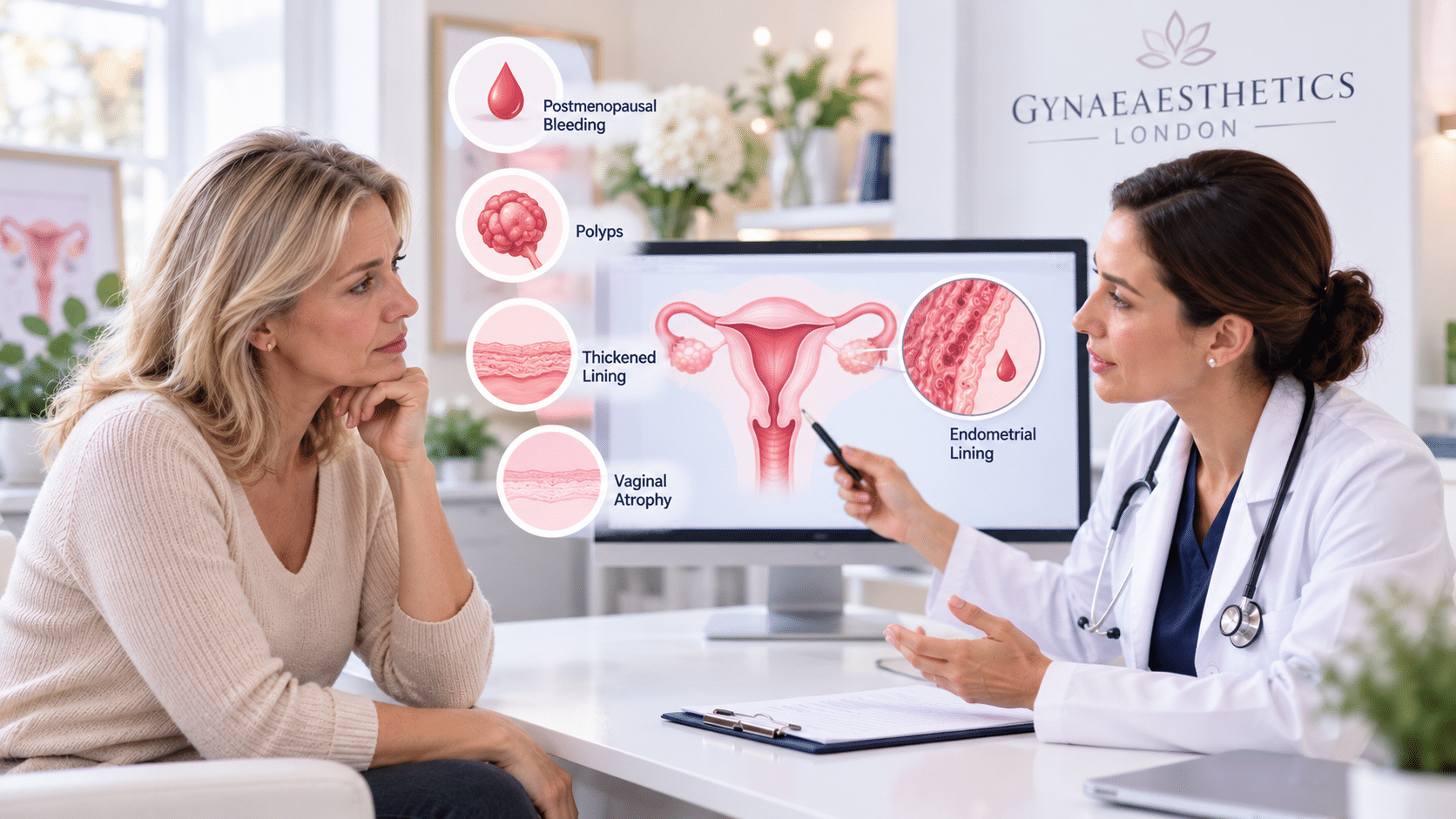
Postmenopausal Bleeding: Why It Happens, What Tests You May Need and When to Seek Help
Bleeding after menopause should always be assessed. Learn about possible causes, ultrasound, hysteroscopy and treatment options.
Menopause is a natural stage of life, marking the end of menstrual periods. However, noticing vaginal bleeding after menopause can be unexpected and worrying.
Whether it appears as light spotting, pink discharge or heavier bleeding, any vaginal bleeding after menopause should be assessed by a healthcare professional.
Although many causes are benign and treatable, bleeding can occasionally be an early sign of a more serious condition, including womb cancer.
At Gynaeaesthetics London, women can explore private gynaecological care for menopause, abnormal bleeding and reproductive health concerns.
What Is Postmenopausal Bleeding?
Postmenopausal bleeding refers to vaginal bleeding that occurs after 12 consecutive months without a menstrual period, when menopause has occurred naturally.
It may appear as:
- Light spotting on underwear
- Pink or brown vaginal discharge
- Bleeding after sexual intercourse
- Bleeding similar to a menstrual period
- A single unexpected episode of bleeding
Even one episode of spotting after menopause should be medically assessed.
Bleeding while using hormone replacement therapy may require a different assessment pathway depending on the treatment regimen, recent changes and individual risk factors.
1. Vaginal and Endometrial Atrophy
After menopause, oestrogen levels decrease. This can cause the tissues of the vagina and the lining of the womb to become thinner.
Vaginal tissue may become more fragile and prone to irritation or minor bleeding, particularly after intercourse.
Associated symptoms may include:
- Vaginal dryness
- Burning or irritation
- Discomfort during intercourse
- Urinary symptoms
- Occasional light spotting
Treatment may involve moisturisers, lubricants or prescribed local vaginal oestrogen after appropriate assessment.
Learn about menopause and women's health services.
2. Endometrial Polyps
Endometrial polyps are growths that develop from the lining of the womb.
Many are benign, but some may contain precancerous or cancerous changes, particularly after menopause.
Polyps may cause unexpected vaginal bleeding or spotting.
They can sometimes be detected during ultrasound, although additional investigation may be necessary.
A hysteroscopy may be recommended to examine the womb cavity and remove a polyp when appropriate.
3. Endometrial Hyperplasia
Endometrial hyperplasia occurs when the lining of the womb becomes abnormally thickened.
It may be associated with oestrogen exposure that is not adequately balanced by progesterone.
Certain types carry an increased risk of developing womb cancer.
A biopsy may be needed to confirm the diagnosis and guide treatment.
Management may include progesterone-based treatment, monitoring or surgery, depending on the findings.
4. Hormone Replacement Therapy (HRT)
Some women experience vaginal bleeding after starting or changing HRT.
For certain regimens, bleeding may be expected, while unexpected bleeding may occur during the initial months of treatment.
The significance depends on:
- The type of HRT prescribed
- How long treatment has been used
- Recent changes to the dose or regimen
- Whether bleeding is heavy or prolonged
- Individual risk factors
Persistent, heavy or newly developing bleeding should be reviewed.
Do not stop or change prescribed HRT without discussing your circumstances with your clinician.
5. Womb Cancer and Why Early Assessment Matters
One important reason to investigate postmenopausal bleeding is to exclude endometrial cancer, also called womb cancer.
Most women with postmenopausal bleeding do not have womb cancer. However, abnormal bleeding is a common presenting symptom among women diagnosed with it.
Early investigation is important because identifying cancer at an early stage may improve treatment options and outcomes.
Risk factors include increasing age, obesity, certain inherited conditions and prolonged exposure to unopposed oestrogen.
6. How Is Postmenopausal Bleeding Investigated?
Medical History
Your clinician may ask about the timing and amount of bleeding, medications, HRT use and relevant family history.
Pelvic Examination
A pelvic examination may help identify vaginal or cervical causes of bleeding. It should be explained and performed with your consent.
Transvaginal Ultrasound
A transvaginal ultrasound uses a small probe placed inside the vagina to examine the uterus and measure the endometrial lining.
In selected patients, a thin womb lining may be reassuring. However, persistent or recurrent bleeding may still require further investigation.
Endometrial Biopsy
A biopsy involves taking a small sample of the womb lining for laboratory testing.
It may help identify hyperplasia, cancer or other abnormalities.
Hysteroscopy
Hysteroscopy involves passing a thin camera through the cervix to examine the inside of the womb.
It may be recommended for suspected polyps, unexplained bleeding or abnormal ultrasound findings.
Pain-relief options and alternatives should be discussed beforehand.
7. Is Postmenopausal Bleeding Always Serious?
Not necessarily. Many cases are caused by benign conditions, including vaginal atrophy or endometrial polyps.
However, symptoms alone cannot reliably distinguish harmless causes from potentially serious ones.
A single episode of light spotting still deserves medical attention.
8. Treatment Options for Postmenopausal Bleeding
Treatment depends on the underlying diagnosis.
| Possible Cause | Treatment Approach |
|---|---|
| Vaginal atrophy | Moisturisers, lubricants or prescribed vaginal oestrogen |
| Endometrial polyps | Monitoring or hysteroscopic removal when indicated |
| Endometrial hyperplasia | Progesterone-based treatment, monitoring or surgery |
| HRT-related bleeding | Review of the HRT regimen and appropriate investigation |
| Endometrial cancer | Specialist oncology assessment and treatment |
9. When Should You Seek Medical Advice?
Arrange a prompt medical appointment if you experience any vaginal bleeding after menopause, including light spotting or pink or brown discharge.
You should also seek assessment if bleeding occurs after sexual intercourse or repeatedly returns.
Heavy bleeding accompanied by fainting, severe dizziness, significant weakness or severe pain requires urgent assessment.
If you are unsure whether blood is coming from the vagina, urinary tract or bowel, a healthcare professional can help identify the source.
10. Preparing for Your Gynaecology Appointment
Before your appointment, it may help to record the following information:
- When bleeding started
- Whether it was spotting or heavier bleeding
- How long it lasted
- Any associated pain or discharge
- Current medications, including HRT
- Previous ultrasound scans or investigations
- Relevant family medical history
Why Choose Gynaeaesthetics London?
Unexpected bleeding after menopause can cause understandable concern.
A personalised gynaecological assessment can help clarify the cause and identify whether further investigation or specialist referral is needed.
At Gynaeaesthetics London, Consultant Gynaecologist Mr Mohammad Masood provides care for a range of women's health concerns.
Explore gynaecology services or visit the Gynaeaesthetics London homepage.
Frequently Asked Questions
Is spotting after menopause normal?
Any vaginal bleeding after menopause, including light spotting, should be assessed to exclude serious conditions.
Can stress cause bleeding after menopause?
Stress should not be assumed to explain postmenopausal bleeding. Medical assessment is needed to identify the cause.
Can HRT cause postmenopausal bleeding?
Yes. Some HRT regimens can cause bleeding, particularly after starting or changing treatment. Persistent or heavy bleeding may require investigation.
What does a thickened womb lining mean?
A thickened endometrium may be associated with polyps, hyperplasia or other conditions. Its significance depends on symptoms, medication use and clinical findings.
Is a hysteroscopy painful?
Experiences vary. Some women have mild discomfort, while others find it painful. Pain-relief and anaesthetic options should be discussed beforehand. You can ask for the procedure to stop.
Can postmenopausal bleeding be a sign of cancer?
Yes, although most cases are not caused by cancer. Postmenopausal bleeding can be an early symptom of womb cancer, so it should be investigated.
How soon should I see a doctor?
Contact a healthcare professional promptly after any episode of bleeding following menopause. Do not wait for another episode.
Book a Private Gynaecology Consultation in London
Experiencing spotting, unexpected bleeding or other concerns after menopause?
Seek personalised assessment from Consultant Gynaecologist Mr Mohammad Masood.
Enquire About an AppointmentMedical disclaimer: This article provides general educational information and does not replace professional medical advice, diagnosis or treatment.